
eCommerce has had two major eras. The first was digitisation — moving catalogs online, enabling card payments, and building delivery networks. The second was optimisation — A/B testing, retargeting ads, personalised recommendations, and conversion rate obsession. We're entering the third era: autonomy.
The autonomous store doesn't just sell products online. It actively finds buyers, qualifies them, personalises their experience at an individual level, handles their questions, recovers their abandoned carts, manages its own inventory signals, and post-purchase, turns customers into repeat buyers — with minimal human intervention in any of it.
This isn't a distant prediction. The building blocks exist today. What's changing is that they're becoming accessible to brands that aren't Amazon.
The death of the static product page
The product page as we know it — fixed images, a description written once, a generic set of reviews — is a relic of the optimisation era. It assumes every shopper is the same, or close enough that one page serves them all.
By 2028, leading stores will serve dynamically generated product pages. The layout, the primary image, the lead copy, the FAQ, the social proof shown — all of it will be assembled in real time based on who is visiting. A professional buyer arriving from a LinkedIn ad sees spec-first content, technical detail, and bulk pricing. A first-time visitor from TikTok sees lifestyle imagery, a simple value proposition, and a low-commitment entry offer. Same product. Completely different page.
The models that power this — trained on your actual customer data, not generic assumptions — already exist. The missing piece for most brands is the infrastructure to serve it at speed and the discipline to feed the model clean data. Both are solvable problems, and they're being solved now.
AI-powered merchandising: the store that curates itself
Merchandising — deciding what products to feature, in what order, in which collections, at what price — is currently done by a combination of human judgement and blunt rules ("show best sellers first"). It's time-consuming, it's inconsistent, and it's based on lagging data.
AI merchandising replaces this with a system that's continuously optimising. It watches what's selling to whom, in which sessions, at which margins. It spots patterns humans miss: that a particular scarf sells 4x better when shown alongside a specific coat, that a mid-tier product consistently outperforms the premium alternative in evening hours, that customers who buy product A within 14 days almost always return for product B.
It adjusts the store in response — not weekly, but continuously. Collections reorder themselves. Bundles surface automatically. Out-of-stock items are hidden and replaced with the next best alternative. Seasonal transitions happen without a human scheduling them.
For multi-SKU stores, this is where the biggest efficiency gains are. The brands running AI merchandising aren't just seeing higher conversion rates — they're seeing higher average order values and better margin mix, because the system optimises for profit, not just clicks.
The AI buyer: how your customers will shop
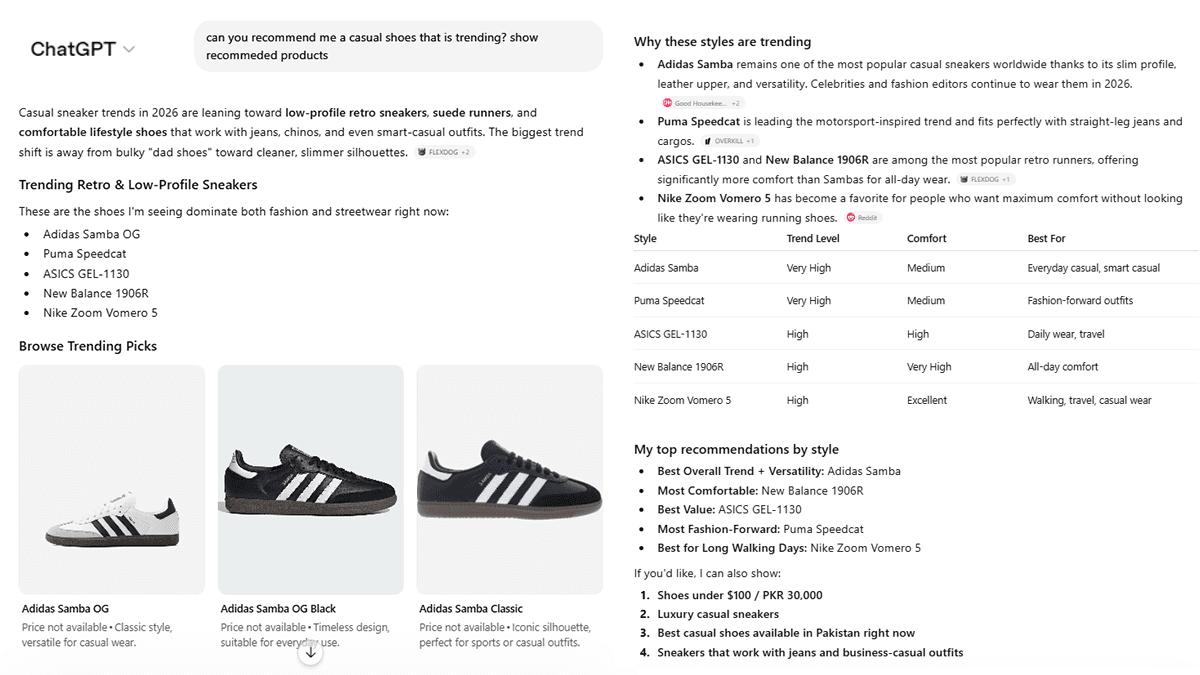
Here's the most disruptive shift most eCommerce operators haven't thought through yet: consumers will increasingly shop through AI agents, not directly through your store.
A user asks their personal AI: "I need a birthday gift for my sister, she's into cooking, budget around £80, needs to arrive by Friday." The AI doesn't open a browser and browse stores. It queries product APIs, compares options across multiple merchants, reads reviews, checks delivery windows, and presents three curated choices with a recommendation. The consumer picks one. The purchase is made. They never visited a product page.
This changes the rules of discovery completely. Your SEO strategy, your PDP copy, your ad creative — all of it was built for a human browser. When the shopper is an AI, the signals that drive selection are different: structured product data, pricing competitiveness, real-time availability, review quality and recency, and crucially, how well your product data is formatted for machine consumption.
The brands that will win in this environment are those investing now in structured data, real-time product feeds, and API-accessible catalogs. The ones optimising their hero image for human Instagram feeds may find themselves invisible to the agents that will route purchasing decisions within three years.
Autonomous customer service: beyond the chatbot
The chatbot era of eCommerce support is ending. Not because chatbots failed — but because they were too limited. They could answer FAQs. They couldn't actually do anything.
Agentic support systems can. When a customer messages saying their order hasn't arrived, the agent checks the live tracking data, identifies the delay, looks at the customer's order history and LTV, decides whether to proactively reship or offer a refund based on your policy rules and the customer's value tier, executes the action, and closes the ticket — without a human touching it. If the issue is outside its authority (a very high-value customer requiring a non-standard resolution), it escalates with full context pre-loaded, so the human picks up a solved problem, not a cold case.
The result: support costs that fall as order volume grows, consistency that no human team can match at scale, and response times measured in seconds rather than hours. For brands at volume, this isn't a nice-to-have — it's the only economically viable model.
Inventory and supply chain intelligence
Stockouts and overstock are two of the most expensive problems in eCommerce. Both are fundamentally forecasting failures. AI is solving this in ways that rule-based systems simply can't.
Modern AI forecasting models ingest a wider range of signals than any human analyst could process: historical sales velocity, seasonal curves, promotional calendars, competitor stock levels (where visible), social trend signals, weather patterns for weather-sensitive products, and supplier lead times. They produce SKU-level forecasts with confidence intervals and trigger automated purchase order recommendations when stock is projected to breach a threshold.
The best implementations close the loop further: the system doesn't just flag low stock, it initiates the PO, sends it to the supplier, tracks acknowledgement, and updates the storefront with an accurate restock date — all autonomously. The human reviews exceptions, not routine transactions.
Personalised pricing: the end of one-price-for-all
Dynamic pricing has existed in travel and hospitality for decades. eCommerce has been slower to adopt it, partly due to customer experience concerns and partly because the tooling was clunky. Both barriers are falling.
AI pricing engines adjust prices in real time based on demand signals, inventory levels, competitive positioning, time of day, and customer segment. A product showing strong demand momentum gets a small price lift. An item with high stock and falling velocity gets a promotional nudge. A high-LTV returning customer gets a loyalty price automatically applied. All of this happens without a pricing manager manually building and scheduling promotions.
The concern that this alienates customers is valid — and addressable. The key is transparency: "members save 12%" is a dynamic price that feels like a reward, not a manipulation. Brands that frame personalised pricing as loyalty-driven rather than demand-driven win customer trust rather than losing it.
What this means for brands building now
If you're running an eCommerce business today, the question isn't whether to adopt any of this — it's in what order, and where the leverage is highest for your specific situation.
The highest-ROI starting point for most brands is customer service automation: it's measurable, the cost reduction is immediate, and the customer experience upside is significant. From there, the sequencing typically goes: AI merchandising (if you have enough SKUs), personalised email and SMS flows, and then the more infrastructure-heavy investments like dynamic product pages and AI forecasting.
The brands that will look back in 2030 and feel like they made the right bets are the ones that started now — not with a massive transformation programme, but with a deliberate first agent, measured its impact, and iterated. The compound effect of twelve months of learning in production is worth more than any model comparison or vendor evaluation.
The autonomous store isn't a disruption that happens to you. It's one you build — if you start building it now.
Fourlines designs and deploys AI-powered eCommerce systems: from autonomous support agents to AI merchandising to agentic lead capture. See how we approach AI Automation, or read about our Pentagon Real Estate agent build.